 StableMoney
What Are Governance Tokens: The Cost of Your Digital Vote
Governance tokens give you a vote in a crypto project, but the size of your wallet often decides how much that vote counts.
- Topic
- DeFi
- Reading time
- 4 min read
- Updated
- 22 Oct 2026
Overview
Maya taps a button on her phone and casts one vote on the future of a project she has never met in person. The token in her wallet is what lets her do it: a governance token gives its holder a part in the project's on-chain decisions.1 The question is how much her single tap really counts.
Governance tokens are digital assets that grant holders the power to vote on and shape the future of blockchain projects and decentralized organizations.
What are governance tokens?
Digital voting shares
A governance token works like a voting share: it lets its holder take part in on-chain governance for a crypto project.1 The goal is to spread decisions across many holders, so that no single company runs the project alone.1 That is why these tokens sit at the centre of many DAOs (decentralized autonomous organizations) and DeFi platforms that put community-led governance first.2
Membership and access
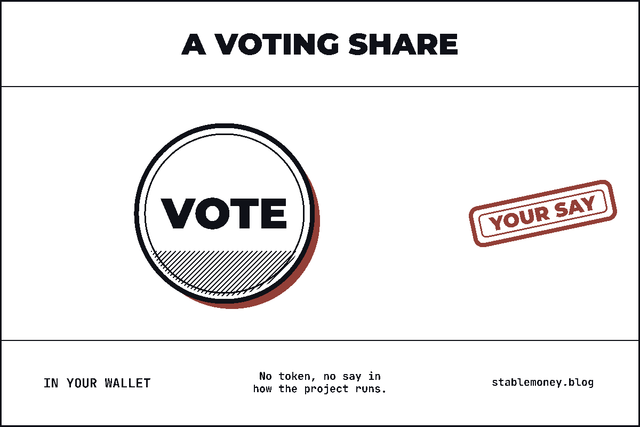
The vote is what makes the token a governance token: if holders cannot vote with it, it is something else.1 You keep the token in your wallet, and that gives you the right to vote on the project. Without it, you can watch the project change, but you have no say in how.
How do these tokens influence a project?
Setting protocol rules
Holders vote on changes to the protocol's rules, which control how the system works.2 The same votes decide how many new tokens are made, which work the developers do first and how the treasury spends its funds.2
| Decision | What it controls |
|---|---|
| Protocol rules | How the system works |
| Token supply | How many new tokens are made |
| Development work | Which work the developers do first |
| Treasury | How the treasury spends its funds |
Directing future growth
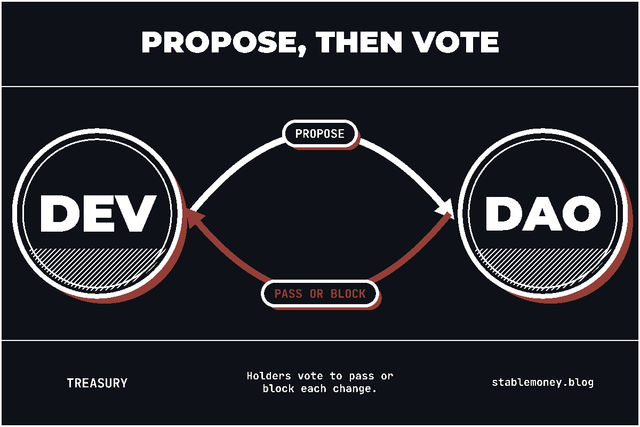
A developer proposes a change to the treasury, and the community uses its tokens to pass or block it. Each vote like this decides where the project goes next. Over time, these votes shape whether the organization grows or fades.
How does the voting process actually work?
The one token one vote model
In most projects, each token you hold is one vote on a proposal, but some projects use other methods.1 The voting runs on smart contracts, which are code that executes automatically.3 You send your tokens to the contract, and the code counts them for you.
Weighting your influence
The more tokens you put into a proposal's smart contract, the more say you have in the final decision.1 So a holder with a large stake has a louder voice than a holder with a small one. When the vote ends, the contract carries out the result.
What are the risks of governance tokens?
Concentration of power
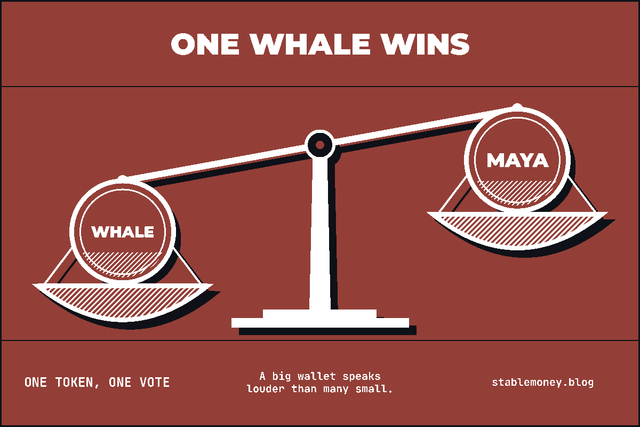
Votes can collect in the hands of a few large holders, called whales, or of groups that vote together.2 When that happens, a DAO that calls itself democratic is run by a few wallets.2
The illusion of equality
A small holder can vote on every proposal and still never change a result. One whale can outvote thousands of people like Maya. A decentralized project is not always a fair one.
| Measure | Small holder | Whale |
|---|---|---|
| Tokens in the wallet | Few | Many |
| Votes per token | One | One |
| Weight in the result | Small | Large |
| Can change a result alone | Rarely | Often |
Maya still has her vote, and it is real. But in a system where tokens decide, the size of a wallet often speaks louder than the voice of the community.
Key Takeaway: Governance Tokens Enable Community Decision-Making
Governance tokens give holders a vote on how a decentralized project is run. Holders decide on protocol changes, new tokens, development work and treasury spending, but large holders often have the most weight.