 StableMoney
How Do Fiat-Backed Stablecoins Like USDC Keep Their $1 Peg?
Learn how fiat-backed stablecoins like USDC keep their $1 peg through full reserve backing, transparent attestations, and arbitrage-driven price correction.
- Topic
- Stablecoins
- Reading time
- 5 min read
- Updated
- 27 Sept 2026
How Do Fiat-Backed Stablecoins Like USDC Keep Their $1 Peg?
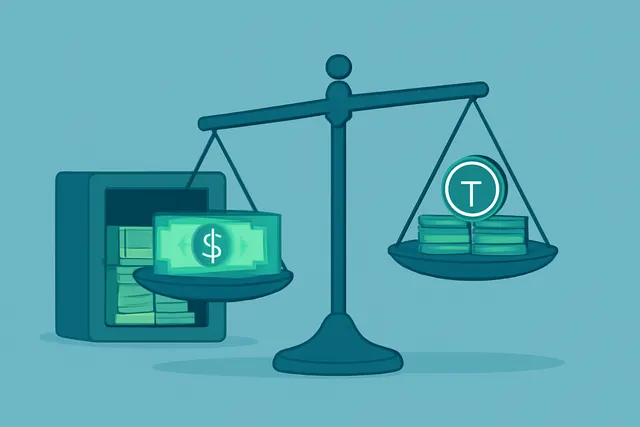
Fiat-backed stablecoins like USDC maintain their $1 peg by holding equivalent liquid reserves and allowing holders to redeem tokens for dollars at par.
What is a fiat-backed stablecoin and why does it target $1?
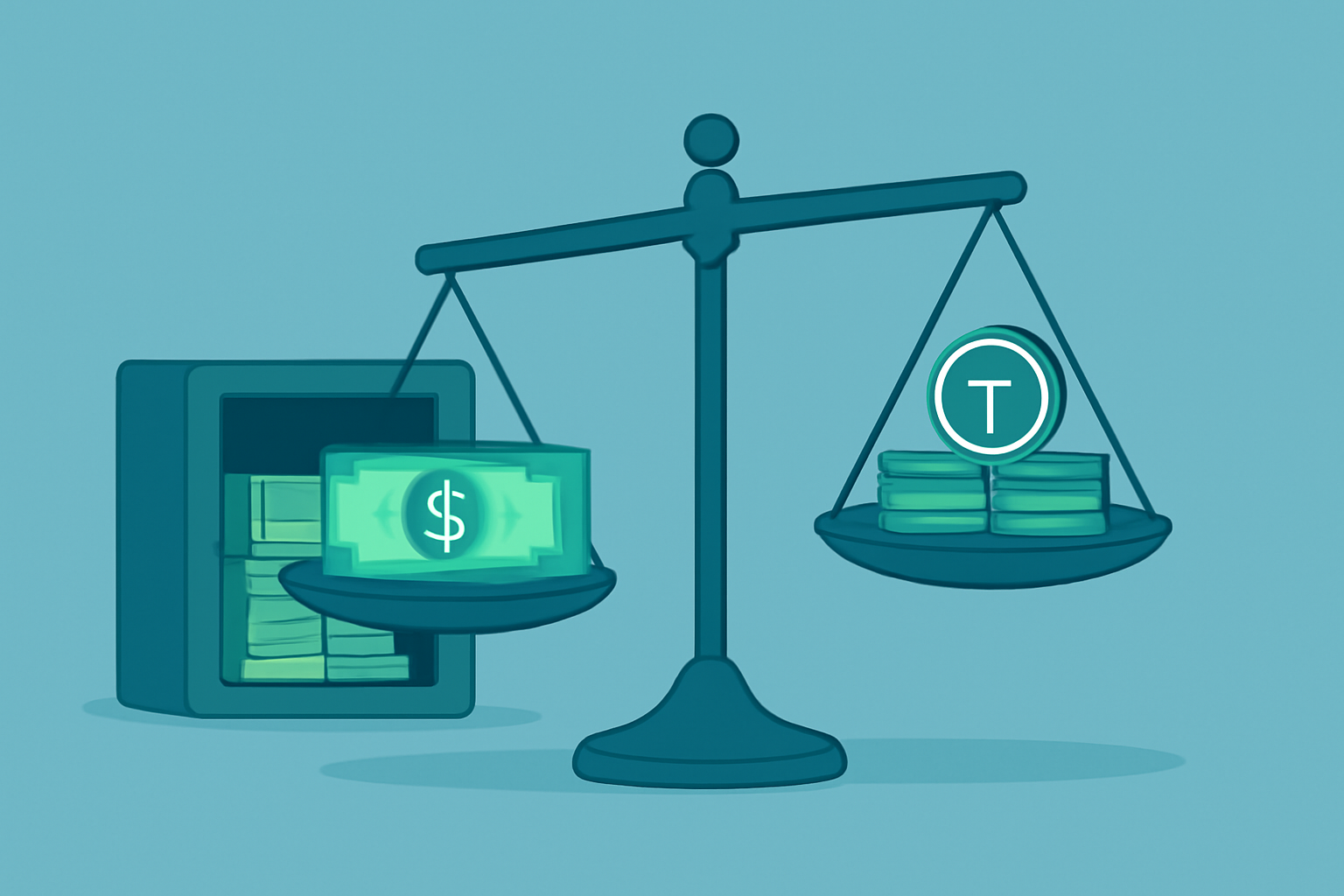
A fiat-backed stablecoin is a cryptocurrency designed to hold a steady value equal to a government-issued currency, usually the U.S. dollar. Unlike Bitcoin or Ether, its price does not swing wildly. Each token is backed by real money and liquid assets held in reserve.
A predictable digital dollar
The token targets $1 because that matches the fiat currency it is pegged to. Users can hold digital dollars without price swings.
Reserves behind the token
Fully reserved stablecoins are backed one-to-one by high-quality, liquid assets such as fiat currency or short-term government securities. Independent custodians and regular audits secure the value.
USDC as an example
USDC is issued by Circle, a major stablecoin issuer. Each token is intended to be worth $1.

How does USDC's reserve backing keep its value at $1?
USDC uses full reserve backing. Every token in circulation is matched by one U.S. dollar held in safe, liquid assets. These assets are cash and short-term U.S. Treasuries. This full backing ensures that each USDC can be redeemed for $1.
High-quality liquid reserves
USDC is backed by short-dated U.S. Treasuries and cash deposits. The majority sits in the SEC-registered Circle Reserve Fund (USDXX), a 2a-7 government money market fund. As of June 30, 2025, USDC held $27B in U.S. Treasuries and $34.4B in cash equivalents. Unlike some stablecoins that hold broader assets, USDC keeps a conservative reserve model.
Segregated accounts protect holders
Reserves are held in accounts that are separate from Circle's own operating funds. They are for the benefit of USDC holders. If Circle went bankrupt, these reserves would not be part of the bankruptcy estate.
Audits confirm the backing
Circle publishes monthly reserve attestations by a Big Four accounting firm. These confirm at least as much in dollar reserves as USDC in circulation. Daily reporting through BlackRock and weekly disclosures add more transparency. The GENIUS Act and EU MiCA rules also require one-to-one backing with liquid assets.

How do minting and redemption enforce the 1:1 peg?
Minting and redemption are the core peg mechanism. Circle Mint lets qualified businesses convert USD to USDC and redeem USDC for USD at par. This creates a direct link between the token and the dollar. Because the mint and redeem price is fixed at $1, any market price deviation creates a profit opportunity.
Minting new USDC
When an authorized institution deposits U.S. dollars with Circle, Circle mints an equivalent amount of USDC. The new tokens enter circulation. For example, a $1 deposit creates one new USDC.
Redeeming USDC for dollars
Qualified businesses can redeem USDC for USD at no cost. Circle burns the USDC received, removing those tokens from circulation. This reduces the total supply.
Arbitrage anchors the price
If USDC trades above $1, arbitrageurs mint new tokens from Circle at $1 and sell them for a profit. If it trades below $1, they buy discounted USDC and redeem it at $1. This buying and selling pushes the price back to $1.
How does transparency and attestation support the peg?
Transparency is essential for a stablecoin peg. If holders trust that each USDC is fully backed, they have no reason to rush and redeem all at once. Circle provides frequent, independent proof of its reserves.
Monthly attestations
Circle publishes monthly reserve attestations by a Big Four accounting firm. These reports confirm at least as much in dollar reserves as USDC in circulation. Daily independent reporting via BlackRock and weekly disclosures allow real-time monitoring.
Regulatory compliance
USDC follows conservative reserve rules. The GENIUS Act mandates one-to-one backing with U.S. dollars and short-term Treasuries. EU MiCA rules require stablecoin reserves to be liquid with a 1:1 ratio of assets to coins.
Preventing bank-run-style redemptions
Confidence in the reserve backing prevents sudden mass redemptions. In March 2023, USDC briefly lost its peg after revealing $3.3B exposure to Silicon Valley Bank. It recovered after regulators guaranteed depositors, showing both the risk and the importance of transparency.
What mechanisms correct the price if it deviates from $1?
Even when USDC trades on open markets, its price rarely moves far from $1. Several mechanisms pull it back quickly and efficiently. Arbitrage is the main force, supported by deep liquidity and automated trading.
Arbitrage in secondary markets
If USDC trades below $1, arbitrageurs buy it at a discount and redeem it with Circle for $1, locking in a profit. If it trades above $1, they mint new USDC from Circle at $1 and sell it on the market. This supply and demand pressure pushes the price back to $1.
Automated market makers and liquidity pools
Large liquidity pools on Curve and Uniswap provide additional stability. Algorithmic traders use these pools to arbitrage small price deviations. Order books show USDC usually fluctuating only between $0.9995 and $1.0005 in a normal 24-hour window.
Stress tests and recovery
In March 2023, USDC temporarily lost its peg after revealing $3.3B exposure to Silicon Valley Bank. It recovered after regulators guaranteed depositors. This event showed that the peg can bend under extreme stress, but arbitrage and redemption mechanisms help restore it.
Key Takeaway: USDC's $1 peg rests on full backing
Every USDC is backed by liquid dollar assets, and mint-and-redeem at $1 lets arbitrageurs correct price deviations. Attestations and transparency reinforce trust in that 1:1 backing.